A Mystery in the Heart of Vienna
In the center of Vienna stands the St. Stephen's Cathedral. Every schoolchild and every tourist knows it.

There is a mystery around this cathedral. You can find below a map from the time of the Ottoman siege. The St. Stephen's Cathedral is in the center of that image.
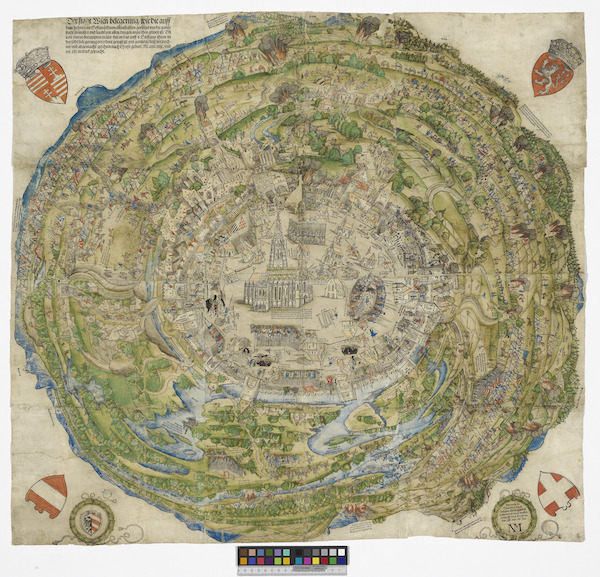

Notice anything strange?
If not, feel free to look at the larger version of the image.
Found it?
If not, here is the solution. There is a Turkish halfmoon on the top of the St. Stephen's Cathedral.
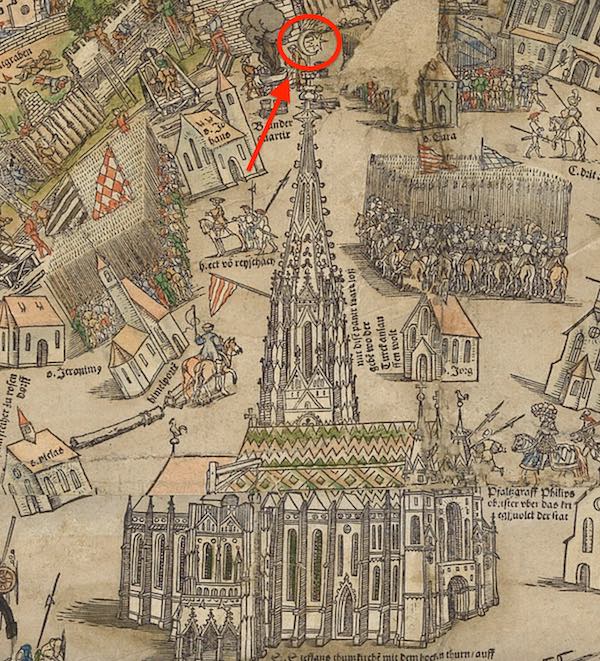
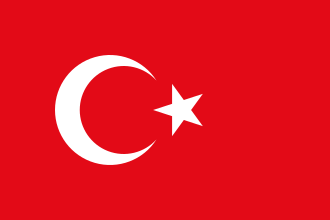
It looks very similar to that on the modern flag of Turkey.
The St. Stephen's Cathedral is a Christian (Catholic) church. Despite two sieges of Vienna, it was never conquered by the Ottomans. Why, then, is there a Turkish halfmoon on top of the St. Stephen's cathedral?
Note that the map above was drawn at a time when Austria and Turkey were at war with each other. The Turks were at the gates of Vienna. Is it reasonable for the Austrians to put a symbol of the very nation they are fighting with on their most important church?
You may say the image in question is fake. Or it is real, but contains fictitious elements. This halfmoon could be as "real" as sea monsters on old maps.
Fair enough.
Except it isn't because that halfmoon was preserved and today is kept in the Vienna Museum (inventory number 561).
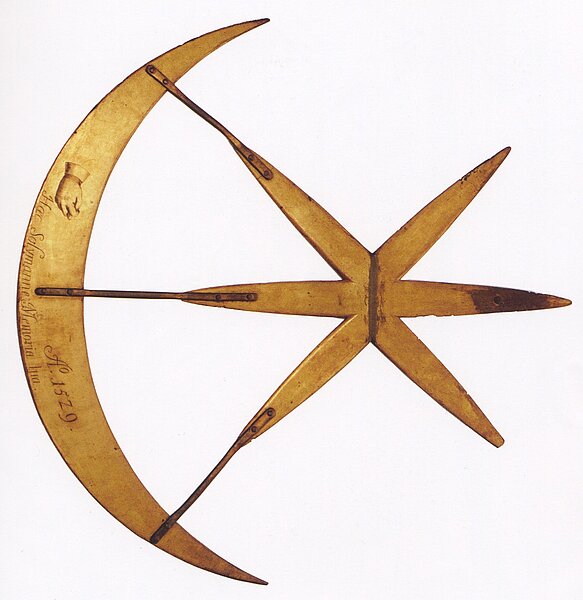
The Austrian academy of sciences claims it is real (translated from German):
Until after the end of the Siege of Vienna in 1683, the spire of St. Stephen’s Cathedral was topped with a star and a crescent moon. To this day, many legends surround this so-called “halfmoon.” Its original meaning had already been forgotten by the time of the Turkish siege, and people viewed it as a symbol of Islam and the enemy Ottomans. For this reason, it was replaced with a cross in 1686.
It doesn't add up. The above quote says the Austrians removed the halfmoon after the war with the Turks. But why did they put it on the spire of St. Stephen's Cathedral in the first place instead of a cross?
This isn't the only instance when a Turkish symbol appears in a Christian country.
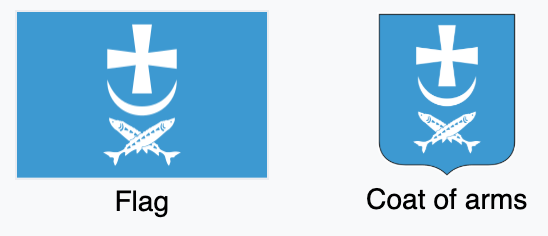
The flag and the coat of arms of the city of Halle in Saxony-Anhalt, Germany contain a rotated Turkish halfmoon as well.

The Ottoman Empire never conquered this part of the world.

If we go farther East, we discover the same situation with the cities of
- Azov, Rostov Oblast, Russia,
- Belozersk, Vologda Oblast, Russia,
- Borzna, Chernigov Oblast, Ukraine,
- Chuguev, Kharkov Oblast, Ukraine,
- Konotop, Sumy Oblast, Ukraine,
- Starokonstantinov, Khmelnitskyi Oblast, Ukraine,
- Ternopol, Ukraine,
- Terebovlia, Ukraine,
- Zinkov, Poltava Oblast, Ukraine.
The cherry on top of this mystery cake is located in the Kremlin in the Church of the Deposition of the Robe. There are seven little towers with onion-shaped roofs. On top of each of them is a rotated halfmoon.

For some reason, the halfmoon that was removed from the St. Stephen's Cathedral was preserved in the Moscow Kremlin.
As far as I know, the standard explanation is this:
- At some point, the Russians conquered some Muslim nation.
- They put the halfmoons on the churches as a way to remember and celebrate it.
I don't buy this explanation. By this logic, there must be swastikas all over Russian cities to preserve the memory of Russians liberating the world from the Nazis.
This didn't happen. A victorious nation may impose its symbols on the defeated one, not the other way around.
If you liked this little riddle you may like my novel. One of its most prominent characters is the city of Vienna. There is so much Vienna in it that even the AI complains about it:

If that's your thing, give my novel a try.