How to use "The Emotional Craft of Fiction" during self-editing
The problem
The book The Emotional Craft of Fiction by Donald Maass contains 34 techniques for making a fiction text better. Many of them are very useful according to my experience.
The problem is that when you are stuck self-editing or writing a particular scene, it can take a lot of time to decide which of those many techniques can be useful at this particular point in time.
In this article I discuss several ways to solve this problem.
Potential solution nr. 1: Woodpecker board
It goes like this:
- You take a particular technique.
- Every morning you read this technique from the book.
- You repeat step 2 for forty days.
- Then you repeat steps 1 through 3 for the next technique from the book.
In this way you will familiarize yourself with all of the techniques and (maybe) will remember which to use when editing or writing a particular scene.
The disadvantage is that you rely on memory which is not perfect and gets worse with age.
Potential solution nr. 2: Visualization
I also tried to visualize the key ideas (relevant to self-editing) from the book as mind maps.
Chapter 3: The Emotional World
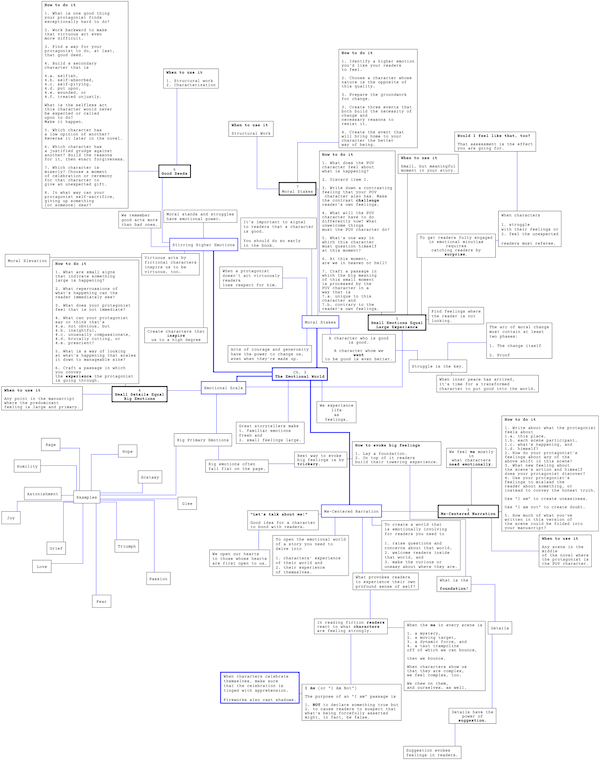
Chapter 4: Emotions, Meaning and Arc

Chapter 5: The Emotional Plot
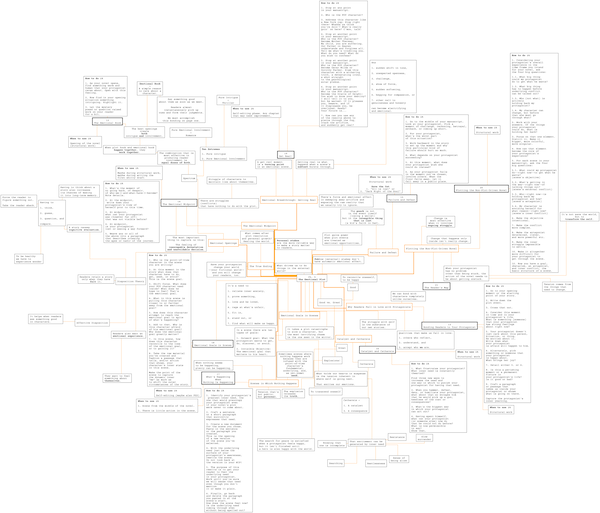
Chapter 6: The Reader's Emotional Journey
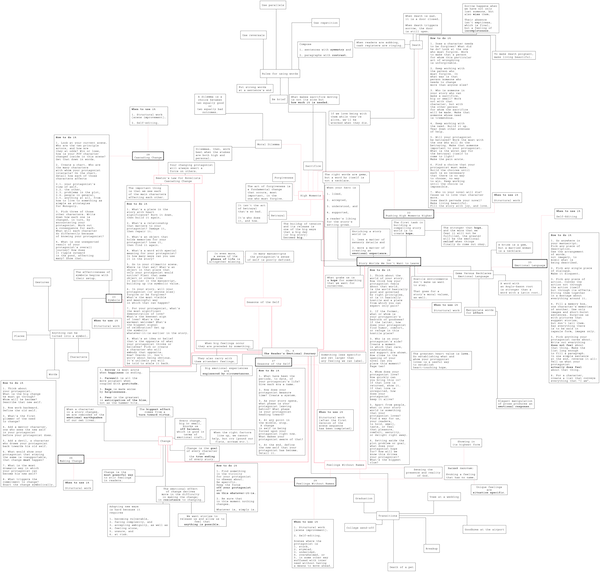
Chapter 7: The Writer's Emotional Journey


Did those mind-maps work?
No. Originally I wanted to print them out and hang at places where I would see them frequently.
Printing them out was a challenge in and of itself: Some of those posters don't fit on a piece of A4 paper. I'd need to cut the image into A4-sized pieces, print them out every page, then glue the pages together.
I was afraid to spend more time tinkering with these posters than actually writing and editing. Therefore I gave up on this idea.
But if you want, you can download all the source files for the above diagrams and render them using Graphviz Dot:
Potential solution nr. 3: A decision tree
The problem with the above approaches is that it takes took long to figure out which technique from the book to use.
So I created a decision tree which makes this process faster.
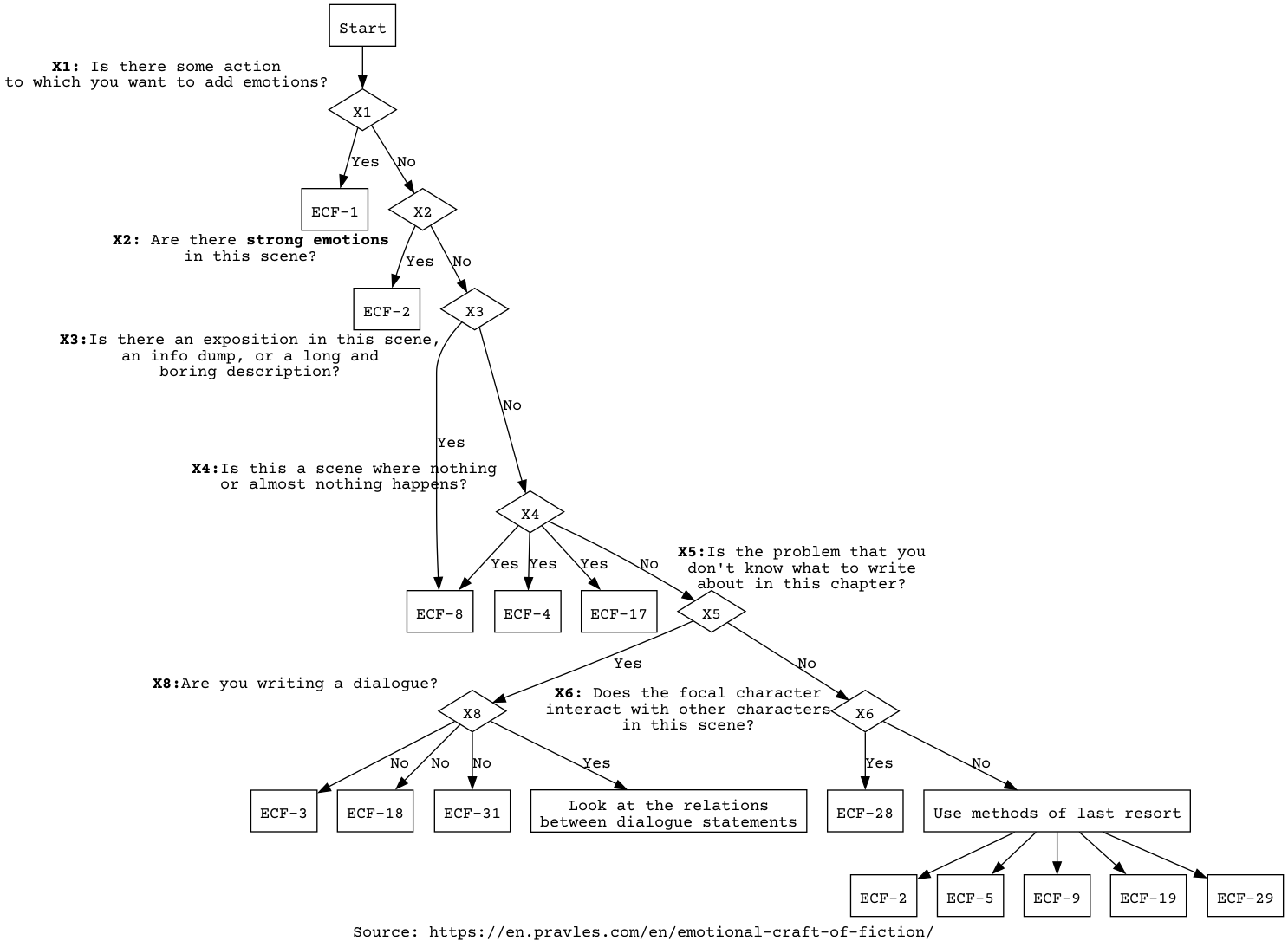
Here is it how it works.
Imagine you are stuck with self-editing or writing some scene (scene is a collection of chapters).
Then you put open the decision tree above and put your finger on the Start node.
You follow the line until you land on a diamond-shaped decision node, e. g. X.1. Every decision node contains a yes or no question.
For example, at the decision node X1 you ask yourself whether or not the problem is that
- something is happening in the scene, but
- it does not evoke sufficiently strong emotions in the reader.
If this is the case, you follow the line labeled with Yes, ECF-1 in this case (ECF means "Emotional Craft of Fiction"). You open the section The Emotional Mastery Checklist in the book, find the first technique there, and then apply it to your scene.
If you answered the question from X1 with no, you go to the next decision node until you either find a suitable technique or arrive at the Use methods of the last resort node.
There is one special node: Look at the relations between dialogue statements. This is not part of the "Emotional Craft of Fiction" book, but can be useful when you don't know what to write in a dialogue.
Relations between dialogue statements
- A dialogue looks like an exchange of statements.
- But in a dialogue those statements are related based on their contents.
- There are many relations between statements, including, but not limited to these:
3.1. clarification (person A talks to person B with the purpose of making sure that A understands B's statements correctly),
3.2. augmentation (person A adds something to a previous statement of person B),
3.3. development (person A develops a previous statement of person B),
3.4. refutation,
3.5. doubting,
3.6. asking,
3.7. problematization etc.
If you don't know what to write in a dialogue, you can
- look at the last statement,
- look at the list above, and
- think which of the relations the statement may exist between the statement from item 1 and the statement you want to write (the one you are struggling with).