Don't Drink Beer for 70 Bucks a Can

There are legends of times long gone. A golden age where the majority of internet users were humans. One human being in one corner of our universe would write something. Another one would read and provide a meaningful answer.
In those times there were no bots. AI slop didn't besmirch the minds. Gauleiters hadn't yet started to erect cyber-ghettos for Russian subhumans (disguised as sanctions). The internet had not yet been discovered by bureaucrats and midwits.
Ye olde internet allowed kindred spirits to enrich each other through mentally and spiritually enriching conversations. We dodged the bullet of toxic loneliness through technology. Geographical distance didn't matter.
Wouldn't it be great if we could bring back those times, one post at a time?
I thought this, when I read the article How to almost write a book for 30 years by Andrea Hoffmann.
In this post I will share some information which may be useful to Ms. Hoffmann, and, maybe, others who are in the same situation, but don't have the balls to admit it publicly.
To Try Is to Accept the Call
The article in question starts with the following statement:
I’ve been trying to write a book for 30 years.
I have the feeling that Ms. Hoffmann believes that trying to write for 30 years isn't much of an achievement. Here is another perspective on the value of trying.
Picture this: It's an evening in the summer of 2005 or 2006. I'm in my mid-20s and recovering from the (so far) biggest catastrophe in my life – the breakup with my first woman and the mother of my child.
I'm in a bus en route to the house of my parents in Döbling, Vienna. I've been (successfully) working to support myself since 1998, but as a result of the breakup my mind doesn't work properly. I can't concentrate for longer than 5 minutes per day which means I can't afford my own accommodation.
When I'm not worrying about money, I self-flagellate myself for not being present for my child and not doing enough for him. I ruminate about suicide a lot. It's an extremely attractive proposition and in the mornings I often fantasize about the building collapsing and killing me quickly and painlessly. The main counterargument is that I have to protect the child from relatives keen on poisoning him with harmful ideologies. I can't do this if I take the easy option.
But right now, in the bus, somehow I don't think about this. I hold a book by Yurii Nikitin in my hands titled How to become a writer. An older guy on the opposite seat, a man from the Caucasus notices the Russian title and we start talking. After the exchange of pleasantries the guy points at the book.
"So you want to become a writer, huh?" the Caucasian guy says.
"Oh, no, no," I say. "Writing fiction is a gift reserved to Heaven's anointed and I'm just a broke guy with a broke psyche and I don't deserve living and I'm an idiot like everybody says I am, let's change the subject."
I didn't say the last part out loud, but I surely acted on it.
The Universe (Providence, Holy Spirit, Jesus, some part of the brain etc.) throws me a lifeline in the form of a book which says exactly what I need to do to save myself on the freaking cover!

The universe knows a thing or two about fault-tolerance and in order to make 100% sure that I receive the message, it also sends me a guy who says the message out loud.
Yet, in 2005–2006 I reject the Call (despite re-reading the book multiple times).
It took me another nine years to finally get the message and start trying to write fiction (in 2014).
I assume that you, Ms. Hoffmann, accepted the Call (started trying) earlier than nine years. This is important because the sooner you start trying the more likely you are to get the Holy Grail of Fiction Writing.
The Holy Grail of Fiction Writing
One can argue that one's fate depends, to a large extent, on our ability to control the psyche. The better you do it, the better you will live. A psyche that functions well generates good ideas which can be turned into good deeds and produce good results for you and others.
Conversely, lots of suffering is caused by suboptimal thoughts and feelings which lead to suboptimal actions. Improve the way you deal with whatever goes on in your psyche and you can reduce suffering (or increase happiness).
The psyche of every human being is as unique as their fingerprint. Therefore everybody has to learn to control their psyche on their own.
Some spiritual traditions try to teach how to maintain a well-functioning psyche at scale. That is, they pretend they do this. I am not aware of any organized religion that actually succeeds in this in a repeatable fashion.
Why do these cults fail?
One crucial reason is the inability to determine how well a person controls their psyche. Imagine you want to get up at 04:00. You can create a little spreadsheet and write down the wake time for a few weeks.
Once you have that data you can calculate how often you missed the target wake time of 04:00. You can calculate your average wake time and determine how far (how close) you are to your target (ideal) wake time of 04:00.
Most importantly, it's that data which tells you whether or not you reached your goal during a particular week.
Of course, keeping track of your wake times does not guarantee you will get up as early as you want. External circumstances like illness or emergencies always can throw you off balance.
But metrics like these make it much easier.
There are no comparable metrics or protocols for estimating how well a person controls their psyche. This is why all organized religions fail at helping their practitioners improve their external lives through improving their internal lives.
Writing fiction allows you to break this spell.
We cannot objectively measure the quality of your or mine unfinished novel. What we can measure is the quantity of output related to a novel.
Here are examples of outputs:
- Scenes outlined according to story grid.
- Scenes transformed to chapters (first shitty draft).
- Self-edited chapters (chapters which ceased to be shitty as a result of self-editing).
Barring strong external factors (stress, emergencies, jolts of inspiration), the number of such outputs you can produce per unit of time depends on your ability to control your psyche.
Whenever you achieve some measurable result (e. g. you complete a chapter in a first shitty draft), you can write it down in a spreadsheet similar to that with wake times.
Do it systematically and you, the fiction writer, get something that a monk lacks: The ability to
- objectively estimate how well or poorly you controlled your mind at such and such time and
- determine whether now you do it better or worse than at some time in the past.
This is both good and bad news.
The Good News
The good news is that a fiction writer can succeed where so-called spiritual folks fail – to actually improve their lives by improving their minds.
Here are a few examples.
Example 1
Working on my novel is the hardest thing I ever did.
Among other things, it's hard because you have to deal with large intellectual objects in your mind (the plot of the novel including the characters, their personalities, their interactions, plus their connections to your own mind).
It's not only fiction writing where we have to turn large objects in our minds this way and that. Any major project, from modernizing a piece of legacy software to moving to a different country to maintaining good relations with an important person requires these skills.
During the last couple of years I successfully implemented two largeish projects at work. The skills which were crucial for successfully completing these projects I developed in scope of working on my novel. Wrecking Improving my brain in scope of writing fiction was my competitive advantage to other programmers.
Here is an analogy. Whenever I work on my novel, I take a backpack weighing 50 kilograms and go by foot to the 20th floor. At work, the hardest tasks require me to ascend to the 3rd floor with 10 kilograms on my back.
Example 2
When I write during the weekends I sometimes use the Pomodoro technique and juggle during breaks. On several occasions I experience the state of no suffering during the juggling break and after having done the writing work.
If I did the preparatory work right, I sometimes feel at peace with myself and the world during the writing work. All this happens without harmful substances and without denial of reality.
During those states I am less likely to lash out at people for no reason which means I act as a better human being.
Example 3
I know how poorly I perform as a writer (soon you will know, too). I know that alcohol, drugs, and non-statutory relations with women are likely to make my performance worse.
Think of alcohol. Let's say a can of beer costs around 3.75 US Dollars (300 Russian Rubles).
If you bought and drank it, how much would it actually cost you?
If you guessed, 3.75 Dollars you would be wrong.
Alcohol degrades your brain's ability to function. Let's say that as a result of drinking that beer you can't properly work for two hours. An average hourly rate of a programmer is about 35 Dollars.
Now let's estimate the actual cost of that can of beer:
3.75 Dollars for the can itself plus 2 hours times 35 Dollars = 3.75 + 70 = 73.75 Dollars
I don't know about you, but I'm hesitant to buy beer for over 70 Dollars a can.
This may not apply to you, Ms. Hoffmann. I hope, it doesn't.
But I do have self-destructive tendencies. When I started to pay attention to how much alcohol really costs me it became easier to control them. If the damage of drinking a can of beer is over 70 Dollars (which is a whopping 1138.70 Austrian Schillings), how much more would a non-classed relation with a woman cost?
If I want to become a pro writer one day, I gotta adopt the lifestyle of a pro writer now. No substance abuse, no destructive relationships, as healthy life as possible. This is one of the ways that doing art can save lives.
(At least it does save mine.)
The Bad News
The bad news is that knowing how poorly you perform as a writer hurts emotionally. The data I collect gives me a detailed, objective picture of my stupidity (the ability to control my psyche).
This is what separates boys and girls from men and women. The former live in blissful ignorance of their weaknesses, the latter confront themselves with the defects of their psyche and do the best to fix them.
Let me show you one way to do it.
The Process of Writing My First Novel Which May Not Be Hopelessly Bad
Around 2019 I was pantsing a novel and realized it was incorrigibly bad. So I decided to try out writing short stories. After writing a few of them in 2020 I realized they were bad too and for the same reason as the novel: Too little was happening in the chapters. This is a defect you cannot fix through self-editing.
In summer 2020 I stumbled across a writing course along the lines of Save the Cat. The course focused on what I call structural work – characters, themes, plot. The reasons why my 2019 novel and short stories were bad were structural, hence if I beefed up my skills in these areas I may become a better writer.
Another good thing about this course was that you got a personal tutor who graded the homework.
I enrolled in this course in August 2020.
Students were supposed to complete this course within three months. I wanted to get the best out of this course and completed the last exercise in May or June 2022.
Let's express the same facts in a way conducive to process improvement.
Note: The diagram below shows the process which I use for the current novel (2020–ongoing). It is not what I will use for the next one. I do not recommend this process and there are flaws in it (which I discovered only in 2025).

I did the first part, Do the structural work in scope of that writing course. The primary result was a list of scenes. Each scene was defined according to story grid. The outline as a whole had all the elements of the hero's journey (Save the Cat is based on hero's journey).
You may say that hero's journey ruined the Hollywood movies. Maybe, maybe not. But doing these exercises definitely helped me fix my primary problem (not enough happens in my novel and short stories). I don't know about the industry in general, but hero's journey definitely helped me solve my most pressing writing problem.
The next step is to Write the first shitty draft. I took each of the 69 scenes and converted it into a piece of text as quickly as possible.
When the first shitty draft is complete, the next phase starts – self-editing. During this phase you rewrite the first draft so that it ceases to be shitty. The only types of defects that will be there are typos and grammar issues.
Those minor issues will be fixed in the next phase – copy-editing. Since I'm not a native English speaker I would hire someone to fix grammar issues and grammatically correct, but unnatural constructs.
Note that the purpose of this diagram is to help you understand the statistics presented below. In practice several things went differently, e. g. I started to copy-edit scenes before the entire novel was self-edited.
Let's now look at the statistics regarding the completed phases.

Note that the Self-Edit phase is not completed yet (the number of hours there will increase substantially once it is finished).
We can represent these data visually.


Structural Work Statistics
The phase Do the structural work (the writing course I took from 2020 through 2022) had 15 lessons or subprocesses.
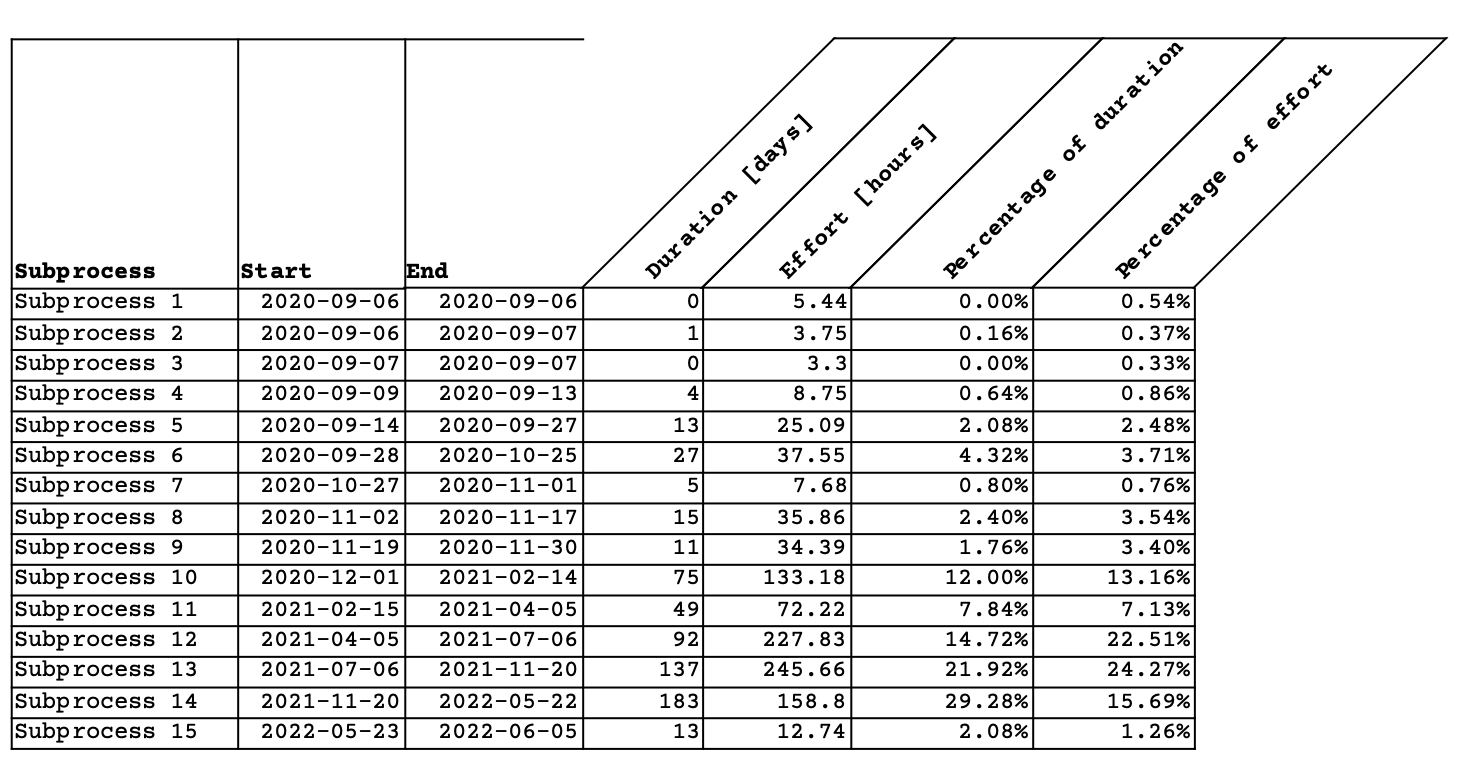

I can use these data to figure out which subprocesses need to be improved first. To do this, we can take the above table and sort it by percentage of effort. Then we can add the column Cumulated percentage of effort where we sum the effort of all preceding phases.

Subprocess 13 contributes 24.27% of total effort. Subprocesses 12 – 22.51%. Together, subprocesses 12 and 13 contribute 46.78% of total effort (last column of the second row).
We continue to sum up the effort contributions until Cumulated percentage of effort reaches or exceeds 80%. The subprocesses highlighted in the above image show 5 subprocesses which are responsible for over 80% of effort related to structural work. Hence, if I were to spend any finite resources on improving my structural work process, I should focus them on those five activities.
Self-Editing Statistics
The chart below hurts me whenever I look at it.

It shows the progress of the self-editing work. I have a first shitty draft with a bunch of chapters for each of the 69 scenes.
In scope of self-editing I take all those chapters and deeply re-work them. Since I learned a few things about writing since I finished the first shitty draft, I can greatly improve the text by rewriting it.
(Which means my first shitty draft is worthless and the time I spent writing it was wasted. That's why I wrote earlier that the described process is not meant to be imitated.)
The blue line shows the percentage of scenes which are self-edited (ready to be proofread by the copy-editor). As of 2025-10-16, 45% of the scenes are self-edited.
The red line shows my expectations of how long it would take to self-edit my novel (three months).
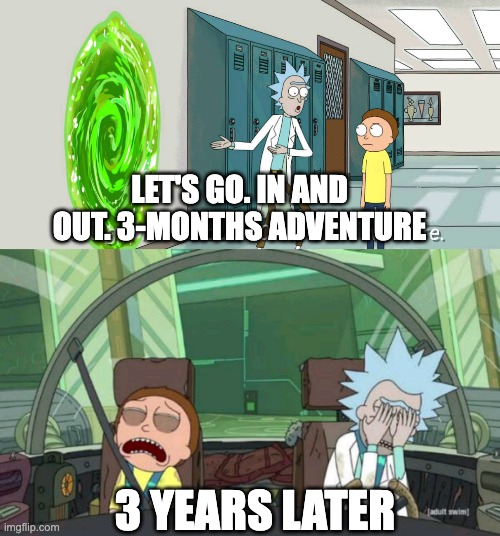
In 2025 the blue line gets steeper (more scenes are being self-edited per unit of time). You may get the impression that the problem is solved… unless you look at the data in a different way.
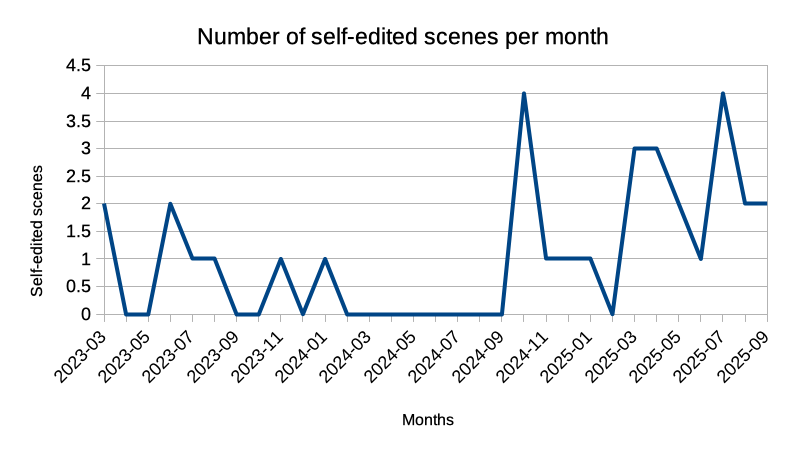
Over the last couple of months I was self-editing, on average, measly two scenes per month. Ouch.
Why Statistics are Important
First, these charts show the level of my ability to control my psyche. Because I compare older versions of myself with newer ones these estimates are scientifically valid.
This is spirituality rooted in reality. If I pray and Jesus (Holy Spirit, the Universe, Providence etc.) answers my prayers and I begin to work better, it will show up in those charts.
Spirituality of this kind does not require blind belief in folks who violate laws of thermodynamics or the goodness of a cause that massacres millions of people century-in, century-out.
Second, these awfully horrific numbers serve as motivators to improve my productivity.
(Successful writers write about ten full-size novels per year, or about one million words per year. It is impossible to do that with my current process represented by the charts above. Another reason to stay away from beer and any other substances which could make those metrics even worse.)
Third, they allow me to determine which measures (like changes to process) work and which don't. This is important because it increases the odds of making a quantum leap in the second novel.
The Second Novel Quantum Leap
I have a theory that the first novel is the training ground for the second and subsequent ones. The first novel is where the writer makes and fixes their worst mistakes. It's where he or she develops those traits of character that separate writers from civilians.
(Every human can write a book. A writer is someone who writes books repeatedly and in a more or less predictable way.)
During writing the first novel the writer gets numerous upgrades of their psyche. They may not notice it during the process, but those changes become evident when they publish their second and third book.
Here is an example you can verify for yourself.
Johnny B. Truant writes in Write. Publish. Repeat. that he started to write his first novel in 1999 and published it in 2011. The worst-case estimate for this novel is
- 12 years,
- 36 pages per year, and
- 3 pages per month.
(According to Amazon, the book has 433 pages. 433 pages divided by 12 years yields 36 pages per year and three pages per month.).
During the year following the completion of his first novel (2012), he published the following works:
- Fat Vampire (162 pages)
- Fat Vampire 2 (158 pages)
- Fat Vampire 3 (158 pages)
- Unicorn Western (105 pages)
In total, he published 583 pages worth of fiction in 2012.
Compared to his first novel (36 pages per year) this is a 16-fold increase in output.
You could claim that this increase in productivity may have something to do with the fact that he teamed up with two other writers in 2012.
I don't believe it. If one lumberjack cuts twenty trees per day, then, on average, three lumberjacks must be able to cut sixty (three times more). If one guy writes 36 pages per year, then three guys should produce three times as many pages, not 16 times more.
Because writing is more similar to programming than to cutting trees I could even argue that three people may have a lower output than one due to increased coordination expenses.
The most plausible explanation for the 16-fold increase in Johnny B. Truant's productivity is that in 2012 he applied the skills of controlling his mind that he developed from 1999 through 2011.
How did he figure out which techniques work or not?
Probably like all other humans: By trial and feedback. The charts above tell you what works and what doesn't. Those metrics may allow me to engineer the dramatic productivity increase in the second and subsequent novels.
The emphasis is on engineer. An engineer makes their decisions based on reality and avoids violating the laws of nature.
How Writers Violate the Laws of Nature
Writers do that all the time when they ask successful writers on their process. You see why that's wrong?
If not, here is the explanation.
Imagine I ask Johnny B. Truant to tell me how he works. Imagine he takes the time and provides as thorough an answer as possible.
Will it be useful to me or others?
Hell no!
First, his process in 2025 works for him and his psyche after 26 years of learning to write. It's like a caterpillar would ask an imago about their process. They are different kinds of beings, with multiple transformative experiences separating them.


Second, what I'm interested in is not how he writes now, but how he got from how he wrote in 1999 to how he wrote in 2012.
If you think a writer can
- meticulously document the changes in their psyche,
- improve their writing skills, and
- earn money to pay the bills (raise kids, maintain the marriage etc.)
over a period of 10-20 years, I've got a really nice bridge to sell you (double-track railway line, four-lane highway).

.jpg)
Third, your psyche is different from that of any other writer's. What's good for the goose may well be good for the gander, but what's good for a Russian is deadly for a German. Writers are closer to Russians and Germans than to geese (due to the fact that every writer's psyche is unique).
To be fair: Trying to imitate a contemporary writer isn't the stupidest thing in the world.
When people think how Shakespeare, Tolstoy, or Dostoyevsky wrote – that's the summit of stupidity. In addition to the three reasons given above, the classics are separated from us by unbridgeable societal differences. Tolstoy and Dostoyevsky lived in a society where 80% of population were illiterate and men lived, on average, for 34 years. Don't you think it would shape their minds in ways unfathomable for people who live wherever you live in the 21st century?
Asking other writers, classical or contemporary, on how you can improve your craft is not engineering. Asking questions by doing experiments on yourself, may.
Practical Implications
Now, you, Ms. Hoffmann, probably expect me to tell you that you should start gathering statistics like I do.
I won't.
What I do recommend is that you go to your favorite café, buy your favorite hot drink, and ponder intuitively on what kind of feedback may work for you. Ideally, you take a walk close to a pond or a scenic park afterwards. For some reason, good ideas on process optimization often come during walks in such places.
(Does the expression process optimization applied to art make you comfortable, Ms. Hoffmann? If so, invent your own one which doesn't.)
I do believe that writing is a control process on a high level of abstraction. This is a useful thinking tool. How you implement this process in practice is individual. It may require all the creativity and knowledge of yourself that you have. This work may be part of your art.
This is not the only way that process optimization may help you, Ms. Hoffmann. Let's look at it from a different angle.
Writers are Baby Murderers
In several countries, when a woman gets pregnant, she has to go to the doctor regularly, ideally with her partner. For every month of the pregnancy, there are certain standardized injections and tests. The goal is to detect any anomalies as soon as possible and maximize the likelihood of a successful birth for the woman and the child.
Now, imagine OB-GYNs would act like typical writers.
Among other things, there would be no tests. Decisions on what medical assistance a particular woman needs at a particular time would be based on opinions of formerly pregnant women at best (or on those who were pregnant centuries ago, at worst).
After the pregnancy of a woman ended, we would toss away any knowledge we gathered and we would not learn from mistakes or successes.
We don't do this to pregnant women because it would be prosecuted by the law enforcement. When writers do the same, no people die, only their dreams. Therefore no police is going to arrest you for writing the first novel like most people do and which makes it harder for all the wrong reasons.
Let's change it in this post.
The Process of Starting to Write
When someone starts to write, I recommend the following process:
- Lay the philosophical foundation.
- Learn structural work in a low-intensity mode (first novel).
- Learn advanced structural techniques (second novel).
Let's look at these phases in more detail.
Step 1: Lay the Philosophical Foundation
Writing fiction is different from many other fields in that in order to even start (or continue, or recover from a slump, or lift a finger to type something) to write you need to adopt a particular mindset. This mindset contradicts the socially acceptable norm.
You can work as a janitor, lumberjack, plumber, programmer, bureaucrat etc. without changing your mindset. You can't as a writer.
Here is an example. Most writers fail. If you want to succeed in a field where most people fail you need to be crazy in a healthy way. Overconfidence is frowned upon in normal life, but is a necessary (though not sufficient) condition for making any writing work at all.
There are several other attitudes healthy for writers and unusual among normal people.
Yurii Nikitin is the only writer I'm aware of who emphasizes this aspect. If you, Ms. Hoffmann, think that learning about these philosophical things can help you make progress with your novel, please leave a comment. Then I will do my best to provide a translation of Nikitin's ideas.
Step 2: Learn Structural Work in a Low-Intensity Mode
I believe that it is structural elements (characters, plot, themes) which contribute most to the joy of reading. Hence, it's structure that a writer needs to master the most.
Structure is hard (just look at the numbers above, the writing course I took from 2020 through 2022). If you start learning structural elements like I did right away, you may get overwhelmed and give up.
This is not what we want.
It's much better to start in a gentle, low-intensity mode. You can do it by doing all the exercises from the book 21 days to a novel by Michael A. Stackpole. I think it's the best book on writing.
Thereafter you will have a structure for your ideas.
Who knows, maybe this is the missing part of the puzzle, Ms. Hoffmann. Maybe after doing these exercises you will make progress with your novel.
If you decide to take a look at the best book on writing I suggest you do it on a day where you don't have any appointments. If it has the same effect on you as it had on me, you won't be able to concentrate on anything after starting to read it.
Step 3: Learn Advanced Structural Techniques
The advanced structural techniques are laid out in the Save the Cat book by Blake Snyder.
Don't be fooled by the approachability of the style of this book or the apparent simplicity of the exercises. Doing these exercises can wreck your brain and lead to sub-clinical depression.
Save the Cat techniques are orders of magnitude harder to apply than those from step 1.
The course I took in 2020–2022 was based on these techniques and one of the reasons I haven't given up was that years before I did perform step 1 (did all the exercises from the 21 Days to a Novel, then crashed in self-editing).
If I was you, Ms. Hoffmann, I'd look at Save the Cat if and only if doing all the exercises from 21 Days to a novel did not give you any breakthroughs.
The Big One
Ms. Hoffmann writes:
The ultimate irony is that I write for a living! I can’t even count how many pages I’ve written for companies and other people, even here… I’ve written hundreds of essays—far more pages than would ever live between the covers of my book.
This sounds like a selective inability to write. You can write certain texts, but not others.
Here is a little question for you: Imagine you are well-rested, i. e.
- you've had enough quality sleep,
- there are no emergencies,
- you are healthy, and
- there are no other extraordinary stresses.
You start to work on your novel. Then, sensations of sleepiness, drowsiness start to occur, but only when you try to work on the novel. If you write whatever you write for a living, everything works fine. When you try to work on your novel, then drowsiness kicks in.
Did something like this happen, Ms. Hoffmann?
If it does, there is good news and bad.
The Good News
The good news is that your novel idea may be a very good one. Some people claim that in order to write a piece of fiction which has "soul" you need to
- take your worst trauma, your deepest and darkest black hole of pain and
- create your fiction around it.
It doesn't mean the novel has to be sad. Planes, Trains and Automobiles is a comedy, but I'm quite sure one of its creators dug deep into their traumas.
Dipping into pain has multiple advantages.
First, you are more likely to finish the project than if you try to write a story about cute little kittens playing with cute little ponies in the best of all possible worlds. Where there is pain, there is energy. The greater the pain, the more energy it can give you.
The fact that you've worked on your novel for 30 years may support this statement.
Second, this makes sure that the material you write about has personal, visceral relevance. You are more likely to tell a story as if you were remembering it. The actual facts may be invented, but your emotions will be real. Then, there is a chance that the reader will feel whatever you feel.
There is a character in my novel who is 100% invented. I haven't, unfortunately, met people like her in real life. On several occasions I cried while rewriting scenes involving that character. If the writer cries, maybe the reader will as well.
If your novel (or the idea your novel is based around) is related to your traumas, then it has the potential to evoke strong feelings in the readers, i. e. become a really good novel.
The Bad News
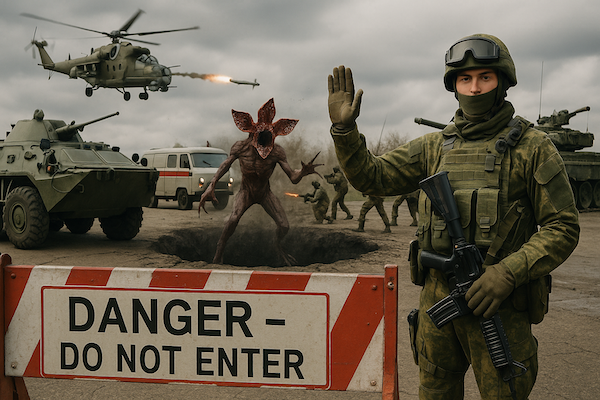
If you did hit gold in form of a black hole of pain, there may be monsters inside it which parts of your psyche consider too dangerous to let out.
You can't finish your novel not because of laziness, or suboptimal work methods, or lack of statistics, but because parts of your psyche believe you can't handle the pain associated with the topic of your novel.
This would explain why you successfully write about (presumably) non-traumatic topics at work, but struggle with the novel.
The Solution
The hypothesis is this:
- Your novel contains material that triggers your traumas.
- These traumas are so strong that letting them out without precautions can be dangerous for yourself and/or others.
- Therefore, parts of your psyche prevent you from working on your novel to protect you.
Here is how you can test this hypothesis in a safe way. Safety is important. If the hypothesis is true, your psyche has been protecting you from something for 30 years. It must have good reasons to do so.
First, find a good specialist in your area who specializes in traumas. EMDR seems to be a well-established trauma treatment. Maybe it's a good idea to find a doctor trained in EMDR.
You don't actually need to do EMDR. What you need is a person who can get you out of a bad state. EMDR-trained specialists work with traumas on a daily basis and should be able to do this.
Full disclosure: I did do EMDR for a long time (about eight years, with interruptions). I had mixed results with it.
Second, organize a meeting with that specialist such that following conditions are met:
- The meeting takes places on such day that after the meeting you don't have any important or stress-inducing meetings for 48-72 hours (e. g. if the meeting occurs on Friday afternoon, Saturday and Sunday should be free of any challenging events).
- You can get to and from the meeting without driving.
- The meeting should take place in person, not via Zoom.
- Ideally, you should refrain from any alcohol before the meeting and take it easy with coffee.
- Bring whatever you need to work on your novel to that meeting (laptop, folder with materials etc.).
These precautions are necessary because when a person gets to know their traumas for the first time, the brain starts to process it and utilizes all available resources. There may not be enough resources left for safe driving or participating in high-stress meetings.
Third, during the meeting with the EMDR specialist try to do some work related to your novel. Maybe there is a specific, self-contained task and if you could accomplish this task, it would be a breakthrough.
Try to work on such task in the presence of the trauma specialist.
Here is why it may work:
- Your psyche protects you from the traumatic material when you work on your novel alone. It reasons like this: If I let the monsters out, Ms. Hoffmann may get into a suboptimal state and do all sorts of suboptimal things. Therefore, I'll turn on procrastination, sleepiness, or make her watch kitty photos on Facebook.
- If you work on your novel with a trauma specialist at the other side of the desk the equation changes. Now, if the monsters come out you have an ally (that trauma guy or gal) who can help you fight or negotiate with them. Also, because there are no important appointments in the following 1-2 days you can afford to be weak after the session. Your psyche may allow you to work on your novel now that it's safe.
If this hypothesis is confirmed you can design your own protocols for working on your novel alone.
Conclusion
Remember the book How to become a writer by Yurii Nikitin? I mentioned it at the start of the article. Among other things, he wrote this in that book (my emphasis):
You are the center of the universe, its brain and its soul at the same time.
It's up to you how civilization, culture, morality, and religion will continue to evolve—what society will be like, what people will be like, what relationships between people will be like!..
Yurii Nikitin was one of the most successful Russian writers when he wrote that. He was one of those Russians who write texts in a way that every word has its function, every word is there for a reason at the right place. The entire text, then, works like a well-engineered machine for conveying meaning from one mind to another.
Look at the highlighted sentence. He didn't write
you, the published writers
or
you, those writers who completed their debut novels.
If he wanted to address those specific types of writers, he would have written it explicitly.
Also, this quote appears in a book titled How to become a writer which suggests that it's targeted at people who haven't become writers yet.
From all this we can conclude that this statement applies to writers who try to write their first novel (among others).
What Yurii Nikitin says there is that you, Ms. Hoffmann
are the center of the universe, its brain and its soul at the same time.
Conversely, without such people, the universe would be devoid of brain and soul. Writing fiction keeps the brain and the soul alive. It's a cause worth living and trying for.
2025-10-23